"Command Code has been the best harness to use this model, they have done a ton of work for tool call repairs and tuning the models output to make sure there aren't many wasted runs!" — Sivaram Pandariganthan, full-stack product engineer
The developer
Sivaram is a full-stack product engineer who builds AI platforms, crypto and payment systems, and smart contracts. As a freelancer, he runs on a lean stack and cares about cost per output. He's been testing the limits of cheaper models to find ones that ship real work without the premium subscription tax.
- Builds: AI platforms, crypto/payment systems, smart contracts
- Stack: JavaScript, TypeScript, full-stack product work
- Find them: Original X post
The bet on DeepSeek V4 Flash
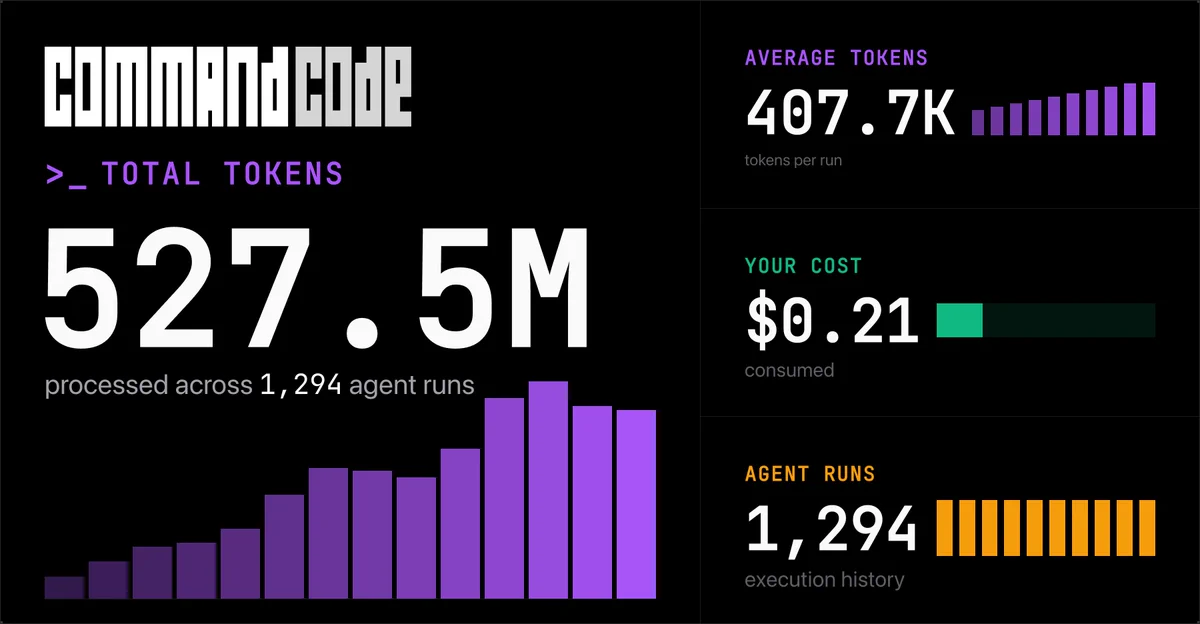
Sivaram spent serious time with DeepSeek V4 Flash — 527,500,000 tokens. His conclusion: the model is a genuine workhorse for the price and it shines in backend JS and TypeScript.
The catch: to get reliable output from a model at this price point, the harness matters more than the model itself.
Why Command Code
Sivaram called out three specific things Command Code does that made DeepSeek V4 Flash viable for production work:
-
Tool call repairs. Command Code tunes the model's output so failed tool calls don't burn turns. On a half-billion-token run, wasted runs compound fast.
-
Vision tool. DeepSeek V4 Flash can't see images. Command Code's vision tool gives text-only models vision capabilities for less than $0.003 per call — Sivaram's words, confirmed by the Command Code team.
-
Cache-friendly sessions. The 1M token context window and cache hit rate are where the cost savings come from. Sivaram's workflow: keep a single session going, keep context debloated, compact and restart if returning after a break.
His cost for 527 million tokens: 20 cents.
The workflow that actually ships
Sivaram's recipe for making a cheap model punch above its weight:
| Stage | Model | Role |
|---|---|---|
| Planning | GPT 5.6 / Opus 5 / Fable 5 | Plan the execution, set guardrails |
| Execution | DeepSeek V4 Flash | Do the work under yolo mode |
| Review | SOTA model | Review output, adjust course |
The key insight: don't be absent. Cheap models lack taste. Pair them with a stronger model for planning and review, and you get the work done at a fraction of the cost.
In their words
"Command Code has been the best harness to use this model, they have done a ton of work for tool call repairs and tuning the models output to make sure there aren't many wasted runs!"
"The major costs saving comes from the 1M token context window and the cache hit rate! Try to keep a singular session going and your context debloated so that you can get the best out of the model by majorly hitting cache for the session as it progresses."
"In the age of expensive subscriptions this might be the workhorse you might find useful in your arsenal."
— @SivaramPg on X, Aug 7, 2026
Why this matters
Sivaram's thread is a real-world stress test of the thesis that the harness matters more than the model. Half a billion tokens at 20 cents isn't a benchmark result — it's a freelancer shipping production work on a lean stack. The takeaway isn't that DeepSeek V4 Flash is the best model. It's that with the right tooling, a cheap model becomes a workhorse.